
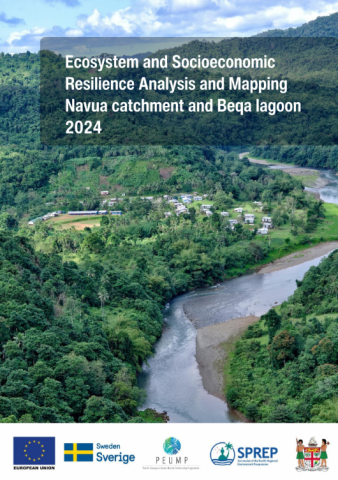
The 2024 ESRAM (Ecosystem and Socio-Economic Resilience Analysis and Mapping) report focuses on the Navau River Basin and Beqa Lagoon in Fiji. The study aims to support the Integrated Ecosystem Management Plan (IEMP) to conserve biodiversity, reduce poverty, and enhance climate change adaptation through an integrated "source-to-sea" approach.
The region's ecosystems, including primary forests, land (excluding forests), inland waterways, and marine/coastal areas, provide essential services related to supply, regulation, culture, and habitat. These ecosystems contribute significant economic value, estimated at billions of Fijian dollars (FJD), particularly coral reefs and mangrove forests.
However, the region faces several serious pressures:
- Environmental degradation: Commercial forestry activities (especially mahogany) cause encroachment, land degradation, and water pollution.
- Overexploitation: Unsustainable fishing practices (including the use of chemicals) deplete biodiversity and fish stocks.
- Climate change: Flooding, erosion, sea-level rise, and waterborne diseases threaten livelihoods, infrastructure, and people's health.
To address these challenges, the report proposes ecosystem-based adaptation (EbA) solutions:
- Replanting mixed-species forests with native species to restore ecological balance.
- Utilizing mangrove forests in conjunction with protective infrastructure to combat coastal erosion.
- Strengthening fisheries management and controlling crown-of-thorns starfish (COTS).
- Improving clean water supply infrastructure and waste management through basin-wide strategies to enhance social resilience.