
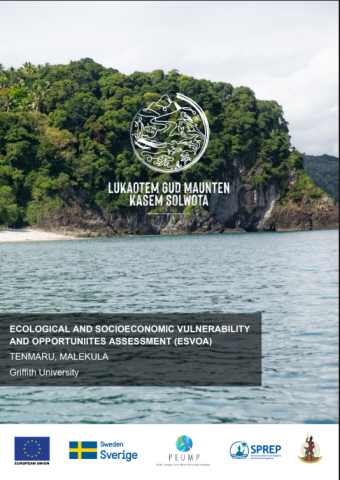
This report presents the results of the Ecological and Socio-Economic Resilience Assessment (ESRAM) in Tenmaru, Malekula, to identify ecosystem-based adaptation (EbA) solutions to enhance the community's resilience to the impacts of climate change.
Key challenges for Tenmaru:
- Rural communities are facing increasing risks from climate change such as storms, sea-level rise, coastal erosion, flooding, and heatwaves.
- Heavy reliance on subsistence agriculture makes people vulnerable to natural shocks.
Methodology:
The research team used a combination of Cost-Benefit Analysis (CBA) and Multi-Criteria Assessment (MCA) to rank potential EbA projects based on economic, social, and environmental criteria.
Priority EbA Projects:
- Highest Priority: Extension services, including establishing demonstration gardens, nurseries, and providing technical support for farming practices.
- Integrated: Extension programs combined with Community-Based Forest Conservation Areas (CCA) and community ranger programs.
- Other: Improvement of sanitation infrastructure, clean water, and sustainable fisheries management (such as fish attractors - FADs).
Implementation and Governance:
- Comprehensive community participation is needed, particularly on Gender, Equity, Diversity, and Social Inclusion (GEDSI) issues.
- Action plans must be consistent with Vanuatu's national policy on sustainable development and disaster risk management.
- Project selection should be based on actual budget, prioritizing "no regrets" projects (highly effective, low-cost) before undertaking larger-scale projects.
Download