
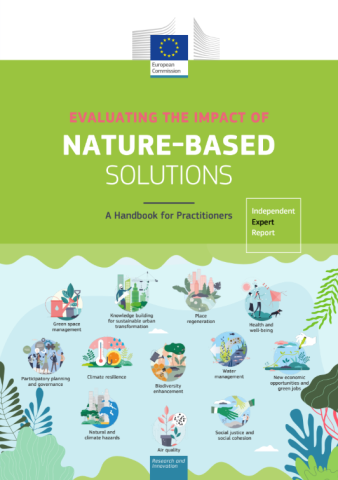
This handbook is a practical guide for professionals on assessing the impact of Nature-Based Solutions (NBS). It was developed by the NBS Impact Assessment Task Force, in collaboration with several EU Horizon 2020 projects, to support the development of an evidence base on the effectiveness of NBS in Europe.
NBS are defined as solutions inspired by and supported by nature, cost-effective, and providing environmental, social, and economic benefits that contribute to resilience.
The main objective of the handbook is to provide a framework for guiding urban professionals in developing robust impact assessment plans, while also providing comprehensive indicators and methodologies. The main contents of the document include:
- Context: Defining NBS and integrating them into international and European policy frameworks.
- Principles: Guides the core principles for assessing the effectiveness and impact of NBS.
- Strategy: A step-by-step approach to developing feasible monitoring and evaluation plans.
Indicators: A catalog of recommended and supplementary indicators across 12 societal challenge areas, including Climate Resilience, Water Management, Biodiversity, Air Quality, and Health/Welfare. - Applications: Case studies illustrating indicator selection and application, including Disaster Risk Reduction (DRR) programs.
- Data: An overview of the types of data, sources, and techniques required for monitoring.
This handbook supports the design and implementation of independent NBS evaluation programs, emphasizing the importance of cross-sectoral approaches and close collaboration with stakeholders to achieve sustainable results.